|
VISITING
A GRAND OLD LADY
A
Voyage Around HIJMS Mikasa
by
Peter
Hunt
Who
is She?
The
Mikasa holds the same historical, and even cultural, significance for the
Japanese as HMS Victory does for the British.
Likewise her famous admiral, Heihachiro Togo, holds a similar place in
Japan
’s pantheon of heroes as Horatio Nelson holds in Britain’s. All represent the finest
hour of their countries’ naval traditions.
Everything in their naval traditions before the climatic battles of
Tsushima
and Trafalgar was leading up to those points.
Everything in their naval traditions afterwards looked back to those
points for inspiration.
|
|
|
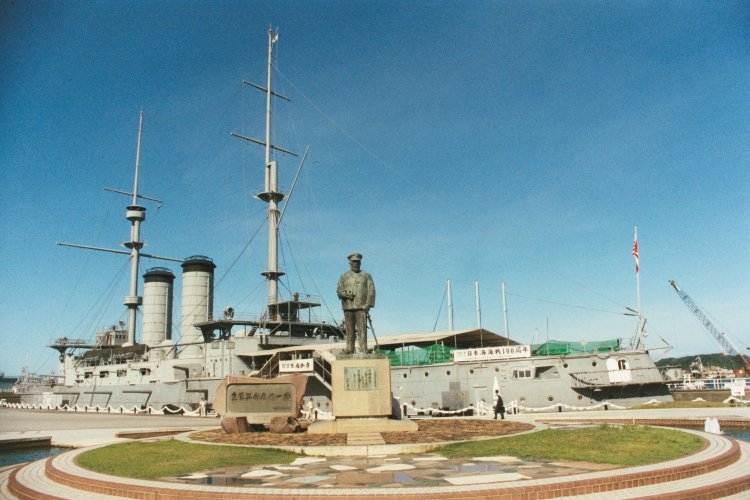
Togo and the Mikasa. |
After
their defeat of China in 1895 the Japanese felt robbed of the spoils of
their victory by the coercion of Russia, France and Germany which led to the
Russians being ceded the Liaotung Peninsula, and trading and military rights
in Manchuria and Korea, which the Japanese saw as theirs alone.
To ensure that they would never again have to back down from the mere
threat of force, the Japanese decided upon a major increase in their fleet.
The resulting “6+6” programme was intended to furnish six battleships
and six armoured cruisers in ten years.
The ships of the programme, (plus two more Italian built armoured
cruisers purchased from
Argentina,) made up the main Japanese naval force in the war with
Russia
which started in February 1904. The
Mikasa was the last of the six battleships built under the programme.
Mikasa
was ordered from Vickers and Sons in Britain in 1898, she was launched in November 1900 and was completed, and became
flagship of the Japanese fleet, in 1902.
In size and power she was a close cousin of the British Formidable
class battleships and, as such, represented the penultimate step in
battleship development before she, and all her sisters, were made obsolete
by the launching of HMS Dreadnought. But,
for her day, she was one of the most powerful ships afloat, displacing
15,140 tons, armed with four 12” guns, 14 6” guns, 20 12 pounder (3”)
guns and four torpedo tubes. She
was protected by nine inches of Krupp cemented armour and the 15,000
horsepower of her reciprocating engines drove her at 18 knots.
In DBSA terms she is the archetypal First Class Battleship.
One
thing that the Mikasa wasn’t was what Royal Navy matelotes would term a
“lucky ship” ~ a ship which survives unscathed through the thick of the
action. Mikasa saw four wars but
the price of her fame came high in the blood of her crew.
She was also more than usually unfortunate when out of combat as
well.
As
Togo’s flagship from the beginning of the Russo-Japanese War, Mikasa took part
in the blockade and actions outside Port Arthur. When the Russian fleet
attempted a break-out in August 1904
Togo
intercepted them in the
Yellow Sea. In the ensuing battle it
seemed at first as if honours on both sides were roughly equal, with the
Japanese, if anything, on the losing end of the exchange.
The Mikasa herself was very badly mauled; her after turret was
knocked out and she took 20 hits. 125 of her 860 man crew were casualties.
However, just as it seemed that the Russians might be able to break
off at dusk and succeed in getting through to Vladivostok a shell from the
Mikasa hit the Russian flagship’s bridge and conning tower, killing the
Russian admiral and causing the flagship to circle out of control, followed
by some of the other Russian ships. By
the time that order was restored in the Russian fleet, the chance of escape
had been lost and they were driven back into Port Arthur
.
The
Russian fleet was only to be eventually destroyed months later as the 11”
howitzers of the Japanese Army picked off the ships inside Port Arthur, whilst Mikasa and the rest of the fleet maintained the blockade outside.
After a much needed refit Mikasa and the rest of the fleet made ready to
meet the new enemy; the Russian Second and Third Pacific Squadrons, in
effect the Baltic Fleet, which had made an epic eight month voyage around
Africa to the
Sea of Japan.
 |
|
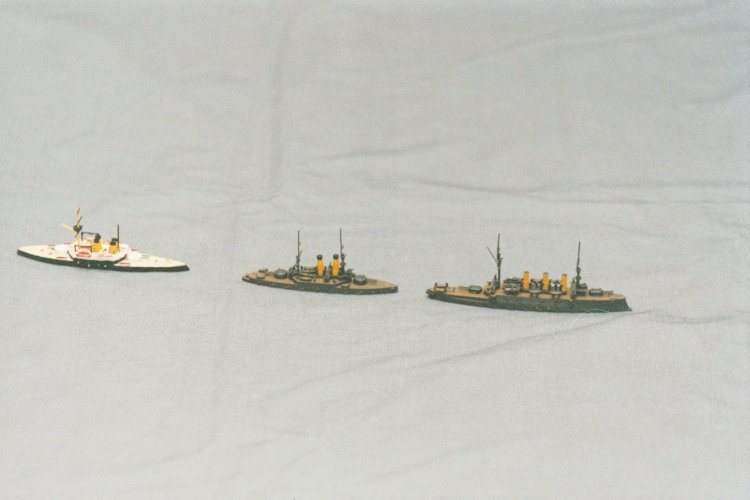
Some of the Russians
at Tsushima. Oslyabia followed by Sissoi and Navarin.
Models by Konishi and scratchbuilt. |
At
1339 hrs on May 27th, 1905 in the straits of
Tsushima
the Mikasa leading the Japanese line sighted the Russian fleet at 13,000
metres.
Togo
was on the starboard bow of the Russians.
If he turned to port he would engage them in a classic fight on
reciprocal courses, this would eventually bring all of his ships under all
the guns of the Russian fleet. If
Togo
turned to starboard he would have to slow down to engage the front of the
Russian line with his whole fleet thus giving the Russian the initiative of
manoeuvre. Instead of these two
weak options Togo
took a calculated risk, crossing the Russian “T” outside of gunnery
range and, as the Russians opened fire, he then turned his line through 180
degrees. This brought him on a
parallel course with the Russians where he could use his speed advantage to
concentrate on the separate parts of the Russian fleet at will.
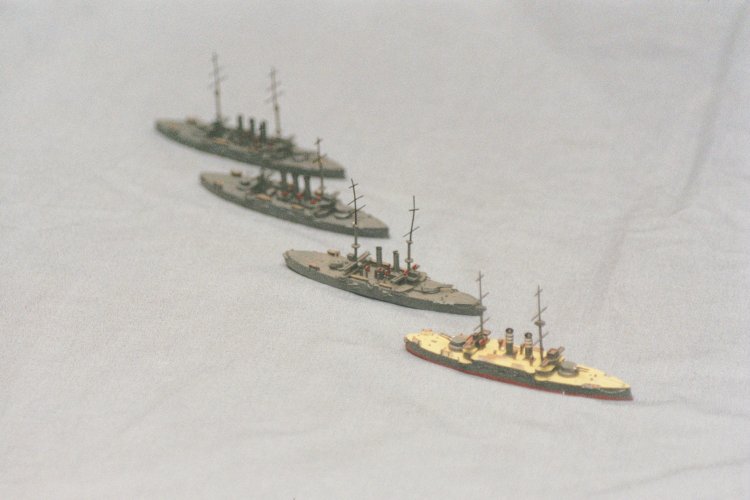 |
| Mikasa and
her consorts. Models by Navis. |
At
Trafalgar, 100 years before
Tsushima, Nelson had made a high risk approach in order to achieve a decisive
advantage to reap decisive results. Like
the Victory the Mikasa bore the brunt of the enemy fire whilst the decisive
manoeuvre was taking place and she was hit 25 times in the first 30 minutes
of the battle. And, like the
Victory flying Nelson’s “England Expects”, Mikasa was flying Togo’s “Z Flag” signal: “The
fate of the Empire depends upon this battle.
Let every man do his utmost.”
The
danger of “Togo’s turn” was that whilst making it, most of the Japanese
fleet would be masked, whereas the Russian fire would be enhanced because
they could fire on a fixed point ~ the knuckle of the turn ~ to which they
already know the range, as each Japanese ship passed through this point.
Like Nelson, Togo had taken a finely balanced risk ~ but his judgement
had been right, and although the Mikasa was badly battered, and one of his
armoured cruisers was knocked out, the Japanese line shook itself out,
returned the fire from a tactically advantageous position and from then on
fought the battle on its own terms. By
the next morning almost the entire Russian fleet was either sunk,
surrendered or in flight for neutral ports ~ only three of the thirty-eight
Russian ships made it to Vladivostok. The
war was, to all effects, over. To
pay for this decisive victory Mikasa was hit 32 times and 113 of her crew
were casualties.
After
all this sacrifice Mikasa was deserving of a safe peace, but it was not to
be. In September 1905, in Sasebo
Harbour, unstable shells in her after magazine ignited, the fire lead to explosions
and Mikasa sunk, taking 339 of her crew with her.
She was raised in August 1906, rebuilt and became fleet flagship
again in 1908. Although she was
active throughout World War One, with the commissioning of Japan’s dreadnoughts, naval technology overcame her.
Mikasa was quickly
relegated to second class, third class, and finally coast defence status.
In this role she suffered the ignominy of running aground off the
Russian coast during the Japanese intervention in the Russian Civil War in
1921. Returning home Mikasa was
holed and flooded during the Great Kanto Earthquake of September 1923.
In
1925 it was decided to preserve Mikasa as a memorial ship and she was
encased in concrete in her home port
of Yokosuka. Even in this state she was not
safe and was extensively bombed during World War Two.
After the war the American occupation authorities confiscated the
Mikasa and ordered her scrapping, but this was low on the priorities in post
war Japan. Then times changed.
The Cold
War started and the Mikasa, which could have been seen as a very potent
symbol of Japanese militarism, was seen as a potent symbol of national unity
against the old enemy who had become the new enemy ~
Russia. Instead of being scrapped the
Mikasa was restored for the second time and re-inaugurated in 1961.
Since then the Mikasa hasn’t been shot at, blown up, run aground or
damaged in earthquakes. Long may
it remain so.
Where
is She?
On
the shore of Shirahama
Bay, Yokosuka, South of Tokyo.
To
get there from
Tokyo
take the Yamanote subway line, which circles most of the tourist areas of Tokyo
to Shinagawa, the fare will be about 200 – 230 yen.
Then change to the Keihin Kyuko line for
Yokohama, Yokosuka
and points south. The fare is
620 yen and the trip to Yokosuka Chuo Station will take about 35 minutes if
you catch one of the limited stop expresses, which are marked with red and
green numbers, or more than twice that if you take the country train which
stops at every station ~ guess which train I caught on the way out?
From Yokasuka Chuo Station it is a five minute walk to the seafront.
The official website is at: http://www.kinenkan-mikasa.or.jp/
although there is little in English. There is further information at: http://www.city.yokosuka.kanagawa.jp/mikasa/gide.html.
What
is She Like Now?
Well
firstly, I hope that I look as good when I am 106!
The
really interesting thing that struck me about treading the decks of a
pre-dreadnought is that the “pre” is really brought home to you.
Compared with other preserved ships that I have visited Mikasa still
seems to have more in common with the Victory, Constitution and Warrior than
with the Texas and Belfast. I’ll
explain this feeling as we take a trip around.
As
you go through the gates you are greeted by a statue of Togo, standing proudly before his flagship.
As a lad
Togo
had served in the shore batteries at Kagoshima
in 1862 when the British Royal Navy had shelled the town and shown up the
dying Shogunate as the weak and antiquated power it was.
Learning from this humiliation, under the Meji Restoration and the
modernization of
Japan, Togo
had become a prime example of the new paradigm: “imitate and overtake.”
Whilst the Japanese Army was modelled first on the French army, then
on the Prussian, the Japanese Navy held a true course in the wake of the
Royal Navy…relying greatly on British shipbuilding, British methods, and
even adopting British naval ethics. Like
the British commanders of the Revolutionary and Napoleonic Wars, Togo was not
concerned about diplomatic niceties when it came to getting the job done.
In July 1894 he had started the Sino-Japanese War by shooting first
rather than let the Chinese get an advantage.
He also had no qualms about sinking neutral British merchantmen in
the service of China. Likewise, in 1904 he attacked
the Russians in Port Arthur
before the formality of a declaration of war.
Togo
was a hard man, always focused on his goal.
As such he was not an easy man to work for.
He seems to have been universally respected and admired by his fleet,
but those who worked closely with him found it hard to love him.
He was particularly difficult in the days running up to Tsushima
because he knew that if the Russian fleet, which had three possible routes
to Vladivostok, slipped past him, the successful outcome of the land war,
which had nearly bankrupted Japan in terms of both manpower and gold, could
be reversed. Finally news came
that the Russian support ships had docked at
Shanghai
and from this Togo
knew that the Baltic Fleet must be heading straight for him rather than
taking the two other possible routes out into the Pacific.
With his strategic judgement proved correct
Togo
could relax a bit ~ all he had to do now was to find and destroy the
Russians, and he never had any doubts he could do that.
|
|
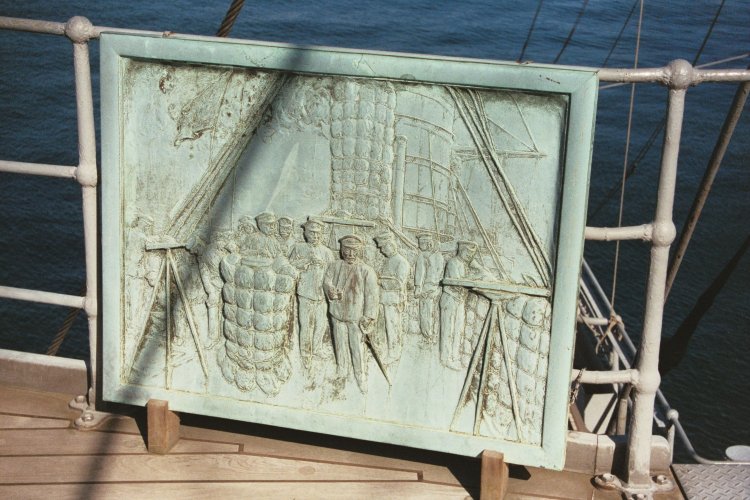
| The bronze
plaque marking Togo's station ~ on top of the pilot house. |
The
statue is based on the famous picture of
Togo
of the flag
bridge
of
Mikasa
at Tsushima. Since the picture was painted
whilst all the participants were still alive there is no reason to believe
that it was not an authentic representation.
This brings us back to the “Pre” thing.
Look at Togo. He is in a
20th century uniform but when he leads his fleet into battle he still wears a
sword, just as admirals would have done a hundred years before, but would
never do again.
Although
Mikasa is encased in concrete up to the waterline this does have one
advantage over most memorial ships which are either dry docked or still
afloat ~ you can get much closer to her.
The affect is only spoiled by a fibre-glass cabin on the port beam
which houses, I think, the electrical transformers.
I’m sure that for technical and safety reasons this white box is
necessary but it does detract from the epic sweep of a 100 year old
broadside.
Entry
is a reasonable 500 yen and for this you get a couple of English guide
pamphlets too. Another 500 yen
will get you the 34 page English guide book.
Once on board your tour can conveniently be divided into two parts ~
above deck and below.
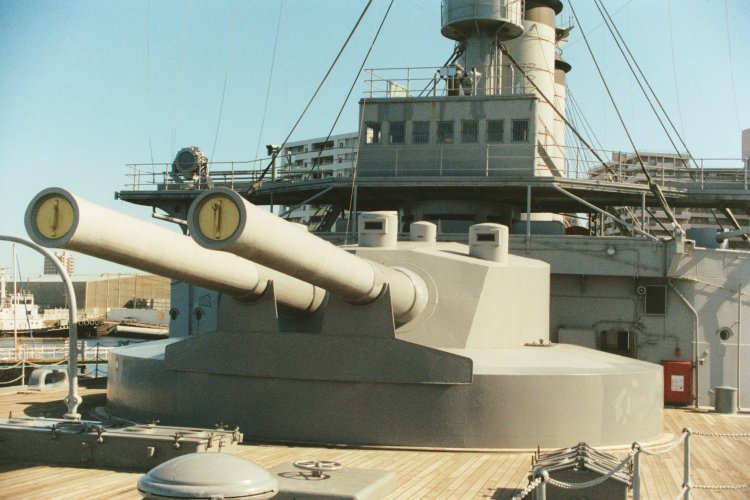 |
| The business
end. Note the sighting hoods on top of the 12" turret and
conning tower under the pilot house behind. |
Starting
above deck, and at the business end, the first thing that struck me was the
prominence of the sighting hoods on the 12” gun turrets fore and aft.
In the days before director control the approximate range to the
target was passed down from a small range finder on roof of the pilot house
to the gun captain in these armoured pimples, and direction given to the
turret crew below. When a gun
was fired a ship’s boy or midshipman would start a special stopwatch
calibrated not in seconds but in metres, with the hand moving at the same
rate as a shell would fly. So if
the range to the target was estimated at, say, 4,000 meters, when the hand
reached 4,000 the boy would shout “splash.”
The gunnery officer in the sighting hood could then judge from the
real splash or hit he saw whether the range estimation was over or under
and, hopefully, could tell the difference between his own splashes and those
of other guns firing at the same target.
|
|
|
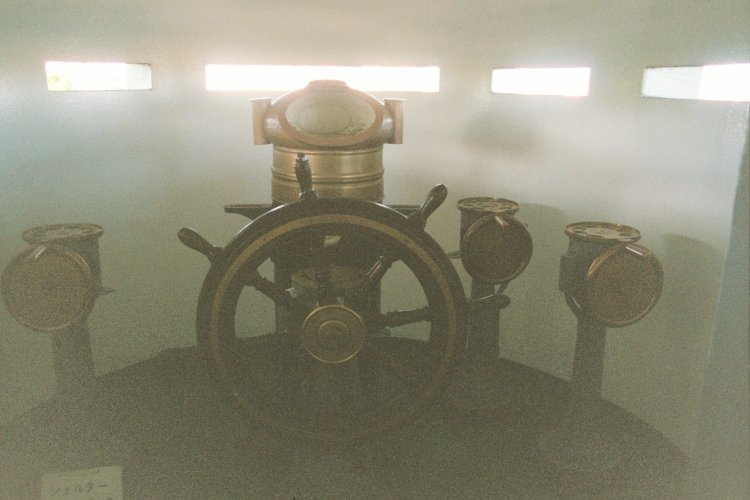
The inside of the
conning tower. |
The
bridgework is a mixture of the old and new in naval warfare.
The armoured conning tower was “state of the art” protection.
Inside the captain, navigating officer and helmsmen would be safe,
even from most direct hits, unless a splinter entered through one of the
narrow vision slits. If shrapnel
or splinters did get in, with any momentum behind them, the results were
devastating as they would rattle around, bouncing off the equally heavily
armoured inside of the tower into the closely packed sailors inside.
Outside of the conning tower on the disengaged side would have been
another midshipman using a sextant to measure the angle to the masthead of
the ship ahead and thus give the captain the separation distance so that the
squadron could maintain proper station.
Exactly the same method was used in Nelson’s day.
Above
the conning tower was the bridge proper, with the wheelhouse and chart room.
On the exposed roof of this stood Admiral Togo
with his staff officers, orderlies and signallers, a battle staff of 12 to
control the fleet. Although this
position was “protected” from splinters by rolled hammocks these were no
use against 12” shells, so Togo
was every bit as vulnerable as Nelson on his quarterdeck.
The alternative was to command from the already crowded conning tower
with poor visibility and poor signalling options.
The British Naval Attaché, Captain Jackson, records that six of the
other seven Japanese admirals at Tsushima followed Togo’s lead, operating from on top of the pilot house, thus sacrificing
personal safety for better command and control.
Given that most of the ships’ crews would have been behind armour
we thus have the very rare military situation where the high command was at
much greater risk than most of the men they were sending into battle.
At the battle of the Yellow Sea a Russian shell took away four of Togo’s staff.
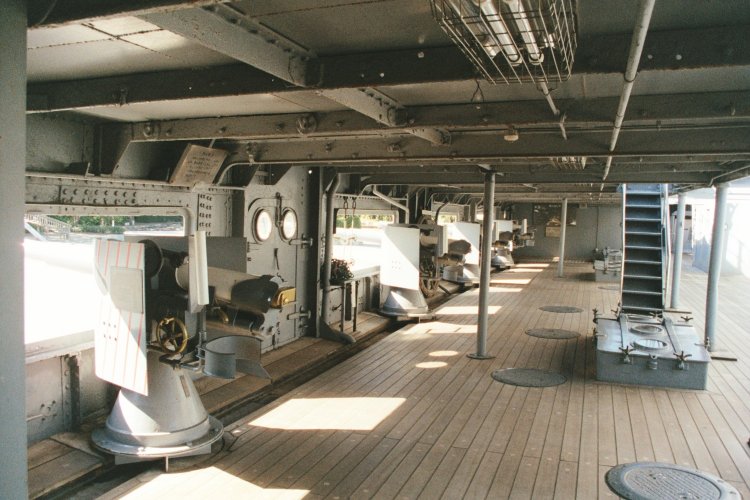 |
| The 12
pounder battery. |
The
12 pounder battery on the upper deck on either side of the funnels is
another place that Nelson would have felt at home ~ an open gun-deck with
guns firing out through ports on the broadside.
In action though it would have been a lot more cluttered than it is
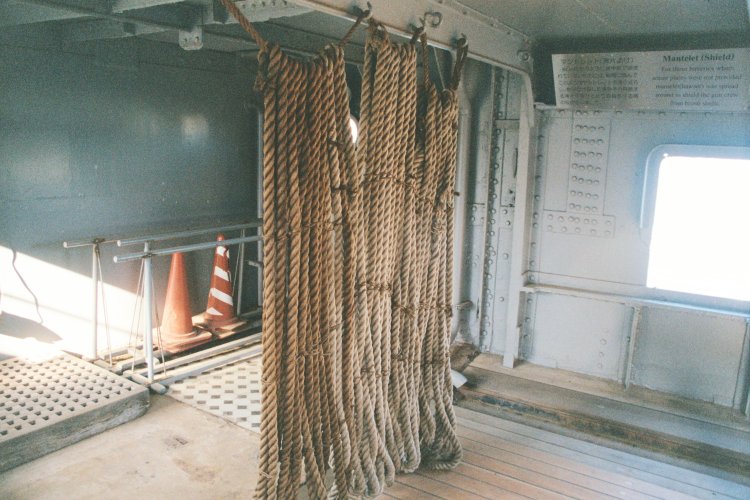
today. Between each gun was a
hemp rope mantelet, a sort of thick climbing net, that was supposed to stop
splinters. The naval historian
D. K. Brown records that British tests in 1893 had shown such mantelets to be
“almost useless.” I hope
that for the peace of mind of Mikasa’s gunners no one told them about the
British tests. Another of
Britain
’s naval attaches to Togo’s fleet, Captain Troubridge, recorded that in one of Mikasa’s sisters,
behind the rear of the guns, was placed a protective barricade consisting of
a pile of gear about six feet high and four feet thick covered with wetted
canvas. This gear sometimes
consisted of “bags of vegetables, principally the vegetable like a long
turnip, so much eaten in Japan.” In a rare omission, in his
otherwise detailed and well written books, D. K. Brown does not record the
results of any British tests on the resistance value of Japanese turnips.
|
|
|
The rope mantelet. |
Before
you go below check out the radio room in the aft superstructure.
Radio telegraphy was in its infancy when Mikasa was built but the
Russo-Japanese War proved its utility. Whilst
Nelson had to guess where Villeneuve was, Togo
was informed over this radio by his scouts that the Russians were in Square
203. This gave a fillip to his
fleet’s morale as Hill 203 had been the key to Port Arthur’s defences, so it was an auspicious number.
Below
decks very little remains of the old Mikasa.
The 6” gun casements have been rather simply restored and some are
used as galleries. The wardroom,
officer’s cabins, (including, because this is a Japanese ship, a splendid
bath) and Togo’s quarters at the stern are still there.
But most of the main deck has been converted into an auditorium and
into exhibition galleries about the ship, the admiral, the war, and about
the Japanese Navy in general.
 |
|
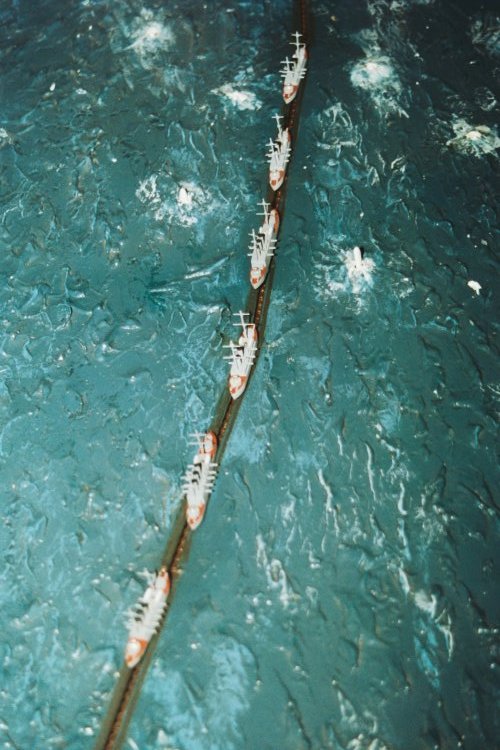
The automated wargame
table. |
If
you like ship models then this is the place for you.
Personally I would have preferred to see the preserved mighty
reciprocating engines like those on the Warrior or the Texas,
rather than a museum, but my slight disappointment was dispelled when I
discovered that the museum has a wargames table with the Battle of Tsushima
set up on it. And it’s the
sort of wargames table we have all always wanted too ~ an automated one!
On a simulated sea the two fleets sail from one end to the other on a
sort of chain mechanism. OK,
when I first saw that the ships were generic types of about 1:1800 scale and
not accurate individual models I was a bit put out, but when little lights
started flashing in the models when the ships fired, and when little water
spouts started rising out of the plasticine sea as the shells fell over and
short, my inner child was totally sold.
Needless to say I pressed the “start” button several times …
Before
you leave the site check out the gift shop for the compulsory T shirt,
prints, ship models and, to celebrate a visit to a fine old lady in the
proper spirit, a bottle of ice cold “Amiral” beer.
With a picture of Togo
on the bottle it is the perfect brew with which to toast the hero, and the
heroine, of battles a hundred years ago.
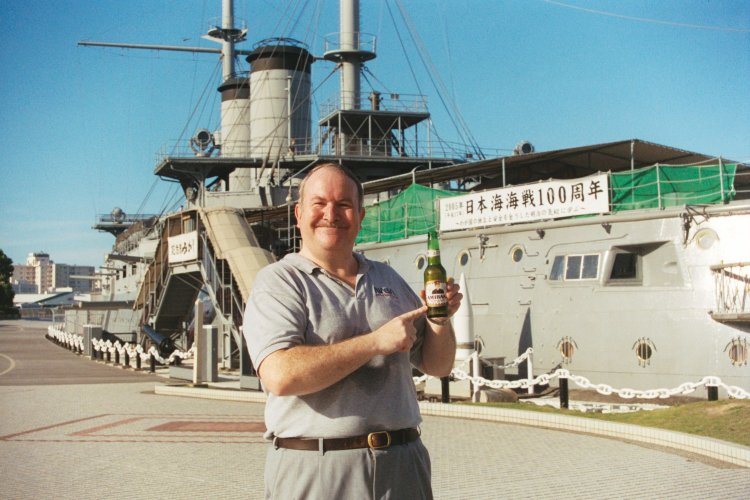 |
| The author
with a bottle of Amiral beer! |
back to
other
periods or
back
to expeditions
|